
Renovating your kitchen is one of the biggest decisions you’ll make as a homeowner. And honestly, once you’ve sorted the layout and the benchtops, the cabinet material is where most people get a bit stuck.
There’s no shortage of options out there — laminate, melamine, thermolaminated vinyl, 2PAC polyurethane — and every tradie and showroom seems to have a different opinion. So let’s cut through the noise.
At Prestige Joinery, we work with Victoria’s best suppliers — Laminex, Polytec, and Nikpol. Here’s our honest take on the most popular kitchen cabinet materials, what they’re good for, and who they suit best.
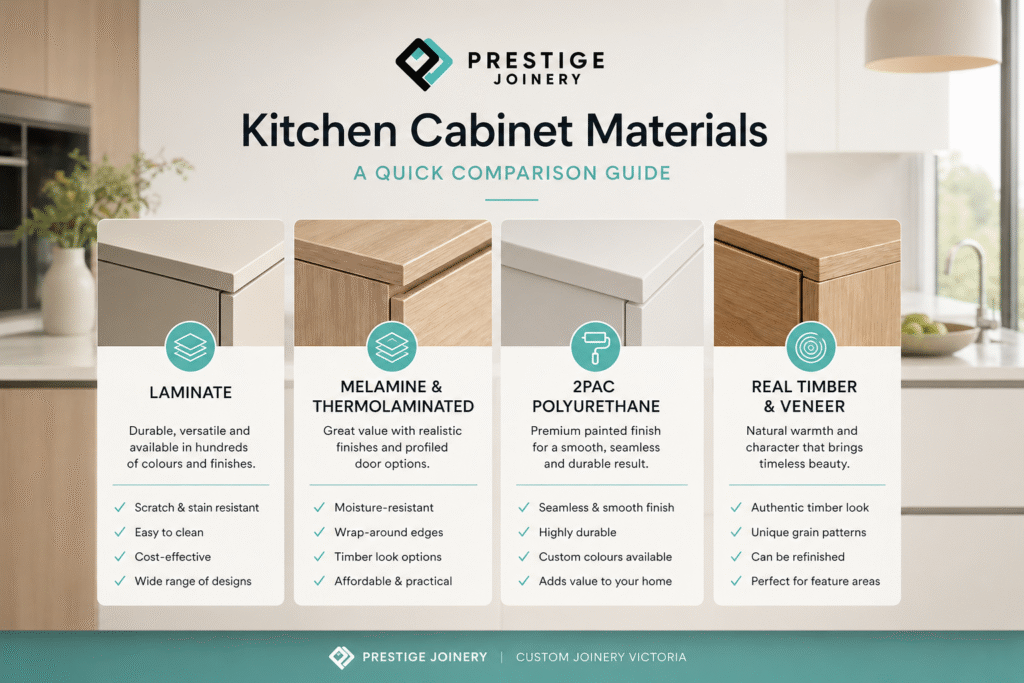
1. Laminate — The Reliable All-Rounder
Laminate is probably the most widely used cabinet material in Australian kitchens, and for good reason. It’s tough, it’s versatile, and it comes in a massive range of colours and finishes.
Laminex is the go-to here. They’ve been part of Australian homes for over 90 years and their Colour Collection is designed specifically around Australian design preferences — think warm timbers, earthy neutrals, and coastal whites that actually suit our light and lifestyle. Their AbsoluteMatte finish is particularly popular right now for its ultra-flat, fingerprint-resistant surface.
Best for: Families, homeowners who want lots of colour and texture options without blowing the budget.
Pros:
- Scratch and stain resistant
- Easy to wipe down
- Available in hundreds of colours and finishes
- Cost-effective and widely available
Cons:
- Edges can chip if knocked hard enough
- Not as premium-looking as 2PAC up close
2. Melamine & Thermolaminated Vinyl — Smart, Practical, Good Value
Melamine is a laminate layer bonded to a particleboard or MDF core. It’s the workhorse of the cabinet world — affordable, moisture-resistant, and dead easy for cabinetmakers to work with.
Polytec is a good brand for melamine and thermolaminated doors, and their range is seriously impressive. Their WOODMATT finish gives you a realistic timber look with a tactile, embossed surface — brilliant if you want that warm, organic feel without the maintenance of real timber. Their ULTRAGLAZE range delivers a high-gloss finish that looks sharp and reflects light beautifully in smaller kitchens.
Thermolaminated (or “vinyl wrap”) takes melamine a step further — a vinyl film is heat-pressed around an MDF core, wrapping neatly around edges and profiles. This means you can get routed door profiles and curved edges that flat laminate just can’t do.
Best for: Renovators on a budget, those who love timber looks, anyone wanting routed or profiled door styles.
Pros:
- Great value for money
- Moisture-resistant core
- Wrap-around finish means no visible edge seams
- Huge range of colours and profiles from Polytec
Cons:
- Vinyl can lift at edges over time if exposed to excessive heat or steam
- Not as hard-wearing as 2PAC for premium finishes
3. 2PAC Polyurethane — The Premium Pick
If you want your kitchen to look like it came out of a magazine, 2PAC is hard to beat. It’s a two-part paint system — an acrylic resin and a hardener — that gets sprayed onto MDF and dries to an incredibly smooth, durable finish. Think of it like a car paint job for your cabinets.
Nikpol is a great brand which supplies the hardware and finishing systems that make premium 2PAC joinery possible. As a 100% Australian-owned company established in 1978, Nikpol has become synonymous with high-quality European design innovation — supplying leading brands like Grass, Egger, and Renolit to the Australian cabinet-making industry.
2PAC can be done in matt, satin, or full gloss. Satin is the one of the most popular choice right now — it looks premium, hides fingerprints better than gloss, and suits everything from coastal whites to deep moody tones.
Best for: High-end renovations, open-plan kitchens, anyone who wants a seamless, paint-like finish.
Pros:
- Beautiful, smooth finish with seamless edges
- Durable — won’t peel, chip or discolour
- Available in virtually any colour (including Dulux chart)
- Adds real value to your home
Cons:
- More expensive than laminate or melamine
- Takes longer to manufacture
- Scratches can be harder to repair
4. Real Timber & Veneer — For Those Who Love Natural Character
There’s nothing quite like real timber in a kitchen. The warmth, the grain variation, the way it ages — it’s genuinely beautiful. Timber veneer (a thin slice of real wood bonded to an MDF or particleboard core) gives you that authentic look at a more manageable price point than solid timber.
The trade-off? Timber needs more love. It can warp or swell with moisture if not sealed properly, and it’s not as forgiving in a busy family kitchen.
At Prestige Joinery, we often recommend pairing a timber veneer island or feature cabinet with Laminex or Polytec cabinetry elsewhere — you get the best of both worlds.
Best for: Design-focused homeowners, feature cabinetry, open shelving and island benches.
So, Which Material Should You Choose?
Here’s a quick cheat sheet:
| Your Priority | Go With |
| Best value | Polytec Melamine or Laminex Laminate |
| Timber look without the fuss | Polytec |
| High-end finish | 2PAC Polyurethane (via Nikpol hardware systems) |
| Lots of colour options | Laminex Colour Collection |
| Routed door profiles | Polytec Thermolaminated |
| Natural character | Timber veneer |
FAQs
What’s the most popular kitchen cabinet material in Victoria right now?
Laminate and 2PAC are the two most commonly requested finishes. Laminate (particularly Laminex AbsoluteMatte) leads in family homes and renovations, while 2PAC is the go-to for high-end builds and custom kitchens.
Is Polytec or Laminex better for kitchen cabinets?
Both are excellent — they serve slightly different purposes. Laminex is brilliant for a wide colour range and flat panel doors. Polytec shines for thermolaminated (vinyl wrap) profiled doors and their WOODMATT timber looks. At Prestige Joinery, we use both regularly depending on the design brief.
How long do 2PAC kitchen cabinets last?
Done properly, 2PAC cabinets can last 15–20+ years without peeling, fading or discolouring. The key is quality preparation and professional application — which is exactly what we do at Prestige Joinery.
Are laminate kitchen cabinets waterproof?
The laminate surface itself is water-resistant, but the substrate (MDF or particleboard) isn’t. It’s important to use moisture-resistant board — which Laminex and Polytec both offer — especially near the sink and dishwasher.
Can I mix materials in my kitchen?
Absolutely, and we’d encourage it. Combining a 2PAC island with Laminex or Polytec upper cabinets is a popular choice in Victoria — it adds visual interest and lets you invest in the right places without blowing the whole budget.
How do I get started with Prestige Joinery?
Easy — just reach out to our team for a free consultation. We’ll come out, take a look at your space, and walk you through the material options that suit your style, your home, and your budget. We work with homeowners right across Victoria.